Your Future
Starts in the Cockpit
The aviation industry is growing faster than it can fill seats. Discover what that means for your career, your income, and your life, and why there has never been a smarter time to start flight training.
Industry Demand
The Aviation Industry Boom and Your Future
The world is short on pilots, and that gap is only getting wider. Right now, airlines around the globe are scrambling to fill captain and first officer seats faster than flight schools can produce them. If job security matters to you, few industries offer what aviation does today.
Boeing projects a need for 660,000 new commercial pilots by 2044. Veteran captains are retiring every day while carriers keep taking delivery of new aircraft to keep up with surging passenger demand. New routes are opening across every continent, creating a steady need for trained, certificate-holding professionals.
In the United States alone, the shortage is forecast to peak at roughly 24,000 pilots around 2026, even as hiring rebounds strongly after a brief slowdown. Air travel is expanding faster than almost any other sector of the economy.
When you start flight training today, you step into a marketplace that desperately needs your skills. You do not have to spend years climbing a corporate ladder before anyone notices you. Airlines are actively searching for new graduates right now, and aspiring pilots from Auburn, Opelika, Columbus, and Tuskegee are already earning their certificates and landing interviews. Your career starts the moment you earn yours.
- New pilots Boeing projects needed by 2044
- 660K
- Projected ilot shortage peak around 2026
- 24K
- Estimated median airline pilot salary today
- $226K
- Flyable days per year in East Alabama
- 200+
Earnings Potential
Command a High Salary Fast
A career in the sky pays. Very well. Most traditional jobs require decades of grinding to crack six figures. As a pilot, your earning power compounds from the very start of your career.
After completing your Commercial Pilot Certificate, you can begin earning immediately. Many graduates work as Certified Flight Instructors while building the flight hours required for the airlines. As a CFI you earn between $30,000 and $50,000 a year while accumulating the experience that gets you hired.
Once you cross over to a regional airline, the income jumps fast. A starting First Officer can clear $90,000 or more in their first year, plus benefits and travel perks that let you see the country on the job. As seniority grows and you upgrade to Captain, your compensation climbs even further. Senior captains earn anywhere from $130,000 to $450,000 annually.
The fastest way to reach those numbers is by completing your training efficiently, from zero experience through your Commercial and CFI certificates, without wasting time or money along the way.
Certified Flight Instructor (CFI)
While building hours toward airline minimums
per year
Regional Airline First Officer
Starting salary, first year
per year
Median Airline Pilot Salary
U.S. Bureau of Labor Statistics
per year
Senior Airline Captain
Depending on carrier and seniority
per year
Financial Comparison
Pilot Training vs. Traditional College
A standard four-year degree costs more and takes longer than most people realize. Our Zero to Hero path gets you earning money years before your college peers ever land their first job.
College Year 1
Pilot Year 1
✈ The pilot starts their career immediately. The college student still has 3 years of study ahead.
College Year 2
Pilot Year 2
✈ The pilot is now $10,000 ahead of the college student on a net-worth basis.
College Year 3
Pilot Year 3
✈ The pilot is now $130,000 ahead of the college student.
College Year 4
Pilot Year 4
✈ The pilot is now $280,000 ahead of the college graduate, before the grad pays a single loan bill.
Average 4-year public college cost
-$124,000
Average student loan debt at graduation
$32K–$36K
Debt repayment eating early paychecks
8–14%
Grads finding work in first 3 months
Only 45%
Average college graduate starting salary
$69,600
First Officer starting salary, Year 3
$90,000+
Return on Investment
The Hidden Costs of a Traditional College Degree
Four-year degrees are often treated as the safe default. But a closer look at the actual numbers tells a very different story. College costs are rising while the return on that investment keeps shrinking.
The average public college tab runs about $124,000 over four years. Graduates typically leave with $32,000 to $36,000 in student loan debt, and that debt eats 8 to 14 percent of early paychecks for years, making it harder to buy a home or build real financial momentum.
Landing a job also takes longer than advertised. Only about 45 percent of graduates find professional employment within the first three months. Many spend 6 to 12 months searching. When they do land something, average starting pay sits around $69,600, and even STEM graduates average only $77,000 at entry level.
Why spend four years accumulating debt for a starting salary that a licensed pilot earns in their first year? Students from Auburn, Opelika, Alexander City, and across east Alabama are already choosing flight training instead, and coming out years ahead financially.
Your Next Step
Start Your Aviation Journey with Blue Skies Above
Your future depends on the quality of your training partner. At Blue Skies Above, we equip you with everything you need to earn your wings efficiently and move into a professional cockpit with confidence.
We operate as a Part 61 flight school, which means flexible, personalized scheduling built around your life, not a rigid academic calendar. Located at Lanett Municipal Airport (7A3), we are easily reachable from Auburn, Opelika, Tuskegee, Columbus, GA, Fort Moore, and LaGrange. You train in uncongested airspace across more than 200 flyable days a year with access to nearby Class C and D airports for advanced work. No waiting for clearance, no idle time on the taxiway.
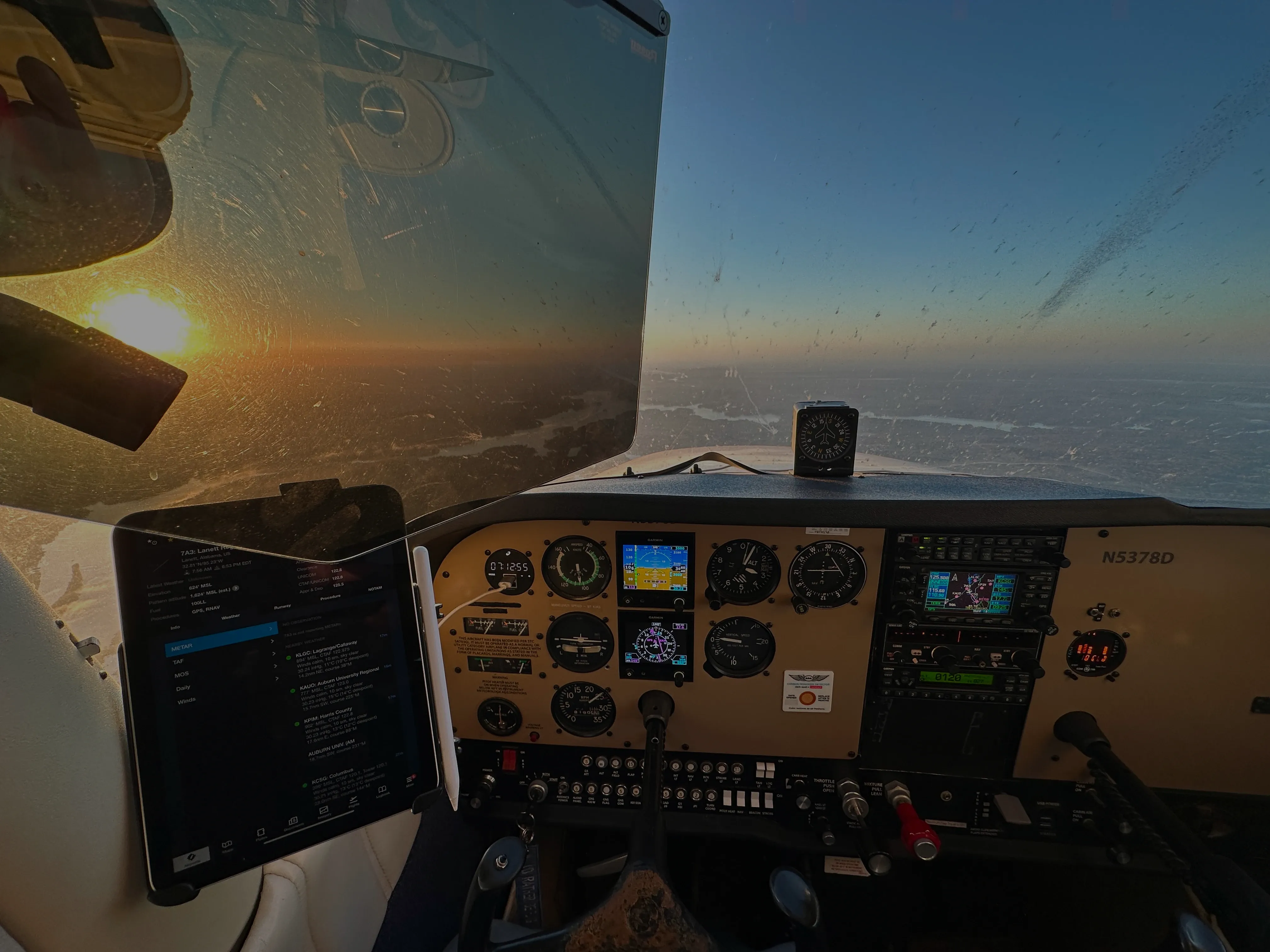
Our fleet of six Cessna 172 aircraft, equipped with Garmin G530, G430, and Dynon Skyview glass panels, puts you behind the same digital instruments used by professional operators. All six aircraft are maintained in-house by our dedicated A&P team, which means fewer surprises and fewer interruptions to your training schedule.
Beginning in August 2025, students can use 529 education savings plans to fund their training. We also work with Stratus Financial to make your path even more accessible. A full Zero to Hero commercial pilot track at Blue Skies Above runs under $100,000, a fraction of what a university program costs.
- Based at Lanett Municipal Airport (7A3), 30 minutes from Auburn and Opelika, within easy reach of Columbus, Camp Hill, and Tallassee. Uncongested, tower-free airspace for focused training.
- 6-aircraft fleet with modern glass cockpits including Garmin G530, G430, and Dynon Skyview HDX. The same tech airlines use.
- In-house A&P maintenance team means fewer delays and a fleet that stays in the air, not the hangar.
- Part 61 flexibility: your schedule, your pace. No rigid blocks or waitlists.
- Zero to Hero commercial path under $100,000. 529 plans accepted starting August 2025.
- Graduates connected to SimpliFly for CFI positions. Your career pipeline starts the day you earn your certificates.
Sources: Boeing Pilot & Technician Outlook 2025 · Epic Flight Academy Airline Pilot Salary 2026 · The Flying Engineer 2026 Salary Report · AeroTime & AviationCV Blog · EducationData & SoFi · ZipRecruiter Annual Grad Report · ThinkImpact 2026 Salaries · Hamilton Project
Ready to Take the Controls?
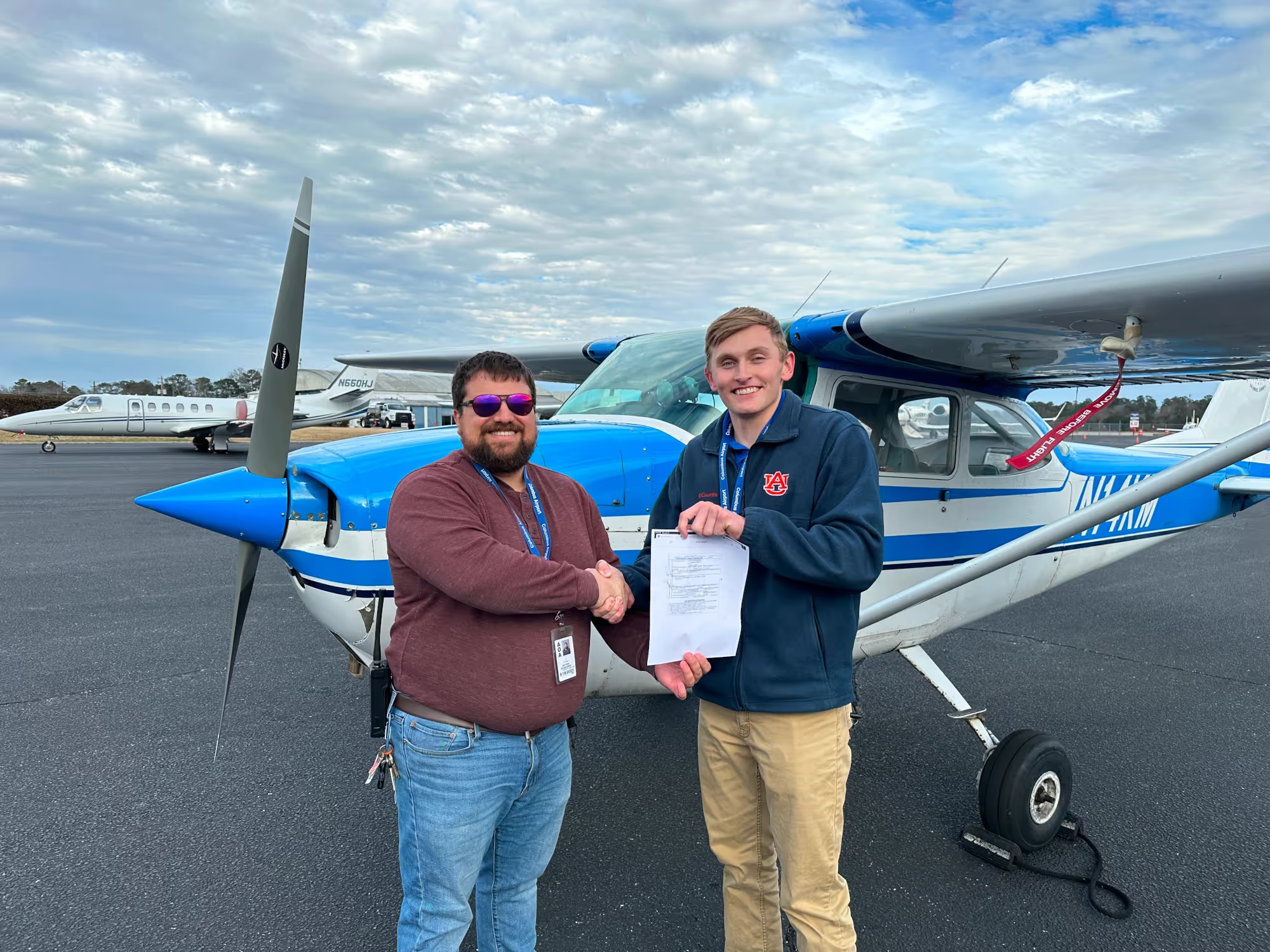
Your aviation journey can begin today with a Discovery Flight at Blue Skies Above. Sit beside a certified instructor, take the controls, and experience the thrill of piloting an aircraft , no experience needed. It’s more than a flight , it’s your first step into a new world of opportunity. See what it’s like to learn in our aircraft, meet our team, and explore whether becoming a pilot is the path for you.